Sixty Pounds Per Square Foot
The City of Flagstaff enforces a design ground snow load of 60 pounds per square foot for site-built residential construction, adopted through its amendments to the International Residential Code in Title 4 of the City Code. Unincorporated Coconino County sets its own figures by elevation: 55 psf in Doney Park, rising to 65 psf above 8,000 feet.
Sixty psf is a serious number. For comparison, most of the country builds to 20 or 30. It exists because Flagstaff sits at about 7,000 feet and its official NOAA snowfall normal is 90.1 inches a year — enough that the structural question is not whether snow accumulates on your roof but how much it weighs when it does.
That number is also the single most useful thing a Flagstaff homeowner can know about their own house, because it raises the question that matters: was your house built to it?
A home built in Flagstaff in 2015 was designed for this. A cabin built in 1965, a converted porch, a carport somebody enclosed, a shed-roof addition a previous owner put on without a permit, or a covered deck added last summer may not have been. Winter roof failures in Northern Arizona concentrate almost entirely in additions, outbuildings, and older structures — not in code-built primary residences.
What Snow Actually Weighs
Snow load is not about depth. It is about water content, which is why the storms that cause structural problems in Flagstaff are frequently not the biggest ones.
- Fresh, cold, dry powder runs very light — a foot of it may weigh only a few pounds per square foot.
- Settled, dense old snow weighs several times as much for the same depth.
- Ice weighs far more again.
- Rain falling on an existing snowpack is the dangerous event. The snowpack absorbs the rain like a sponge and its weight can jump dramatically in hours, with no visible increase in depth.
Add drifting. Wind loads snow unevenly, piling it deep in valleys, against dormers, on the lee side of ridges, and — most commonly in claims — on the lower roof where an upper roof sheds onto it. A garage roof beneath a two-story elevation can be carrying several times the load of the roof above it.
What a Homeowners Policy Covers
Most Flagstaff homes are on an HO-3 form, where the dwelling is covered on an open-perils basis and contents on a named-perils basis. For winter, three specific named perils matter.
Weight of Ice, Snow, or Sleet
This is a standard covered peril for damage to the building. If accumulated snow load cracks a rafter, deflects a ridge, or collapses a roof, that is covered.
The exclusions attached to it are where the surprises live. The weight-of-snow peril typically does not extend to:
- Awnings, canopies, and shade structures
- Fences
- Patios, pavement, and walkways
- Swimming pools, hot tub enclosures, docks, and retaining walls
So the pergola over your back patio and the carport at the end of the driveway are commonly the two things a homeowner most expects to be covered and most often is not. If you have a detached structure you care about, ask specifically how it is treated.
Collapse
Policies define collapse narrowly and deliberately. Modern forms generally require an abrupt falling down or caving in such that the structure cannot be occupied for its intended purpose. A roof that is sagging, bowing, cracking, bulging, or settling is explicitly stated *not* to be a collapse — even when it is obviously failing and obviously needs work.
This is the definition that produces angry claim conversations. The homeowner sees a roof visibly deflecting under three feet of snow and reasonably calls it a collapse; the adjuster reads a policy that says a bulge is not a collapse.
There is a practical implication and it is not intuitive: the deflected-but-standing roof is often the uncovered one. Get a structural opinion, document the deflection with photographs and measurements over time, and do not assume waiting for it to actually fall improves your position — the "neglect" exclusion runs the other way.
Freezing of Plumbing
Burst pipes are covered, with a condition attached that catches Flagstaff's large seasonal-cabin population: if the dwelling is vacant or unoccupied, coverage for freezing generally applies only if you used reasonable care to maintain heat, or shut off the water supply and drained the system.
If you own a Flagstaff property you do not occupy in January, that sentence is your policy. Maintain heat and be able to prove it, or winterize properly.
This is not a niche situation in Coconino County — it is the dominant one. Census American Community Survey estimates for 2020–2024 count 11,808 housing units in Coconino County held for seasonal, recreational, or occasional use. That is roughly one in six of every housing unit in the county, and about three-quarters of all vacant units. A county where a sixth of the housing stock is empty for much of the winter is a county with a very large frozen-pipe and vacancy-clause exposure, and most of the owners carrying it have a standard homeowners policy that was underwritten as if they lived there.
If your Flagstaff property is a second home or a cabin, ask your agent directly how your policy defines vacant and unoccupied, what the day count is, and what coverage narrows once you cross it. Low-temperature alerting and an automatic water shutoff are cheap next to a burst supply line that ran for nine days.
Ice Dams: Covered, With an Asterisk
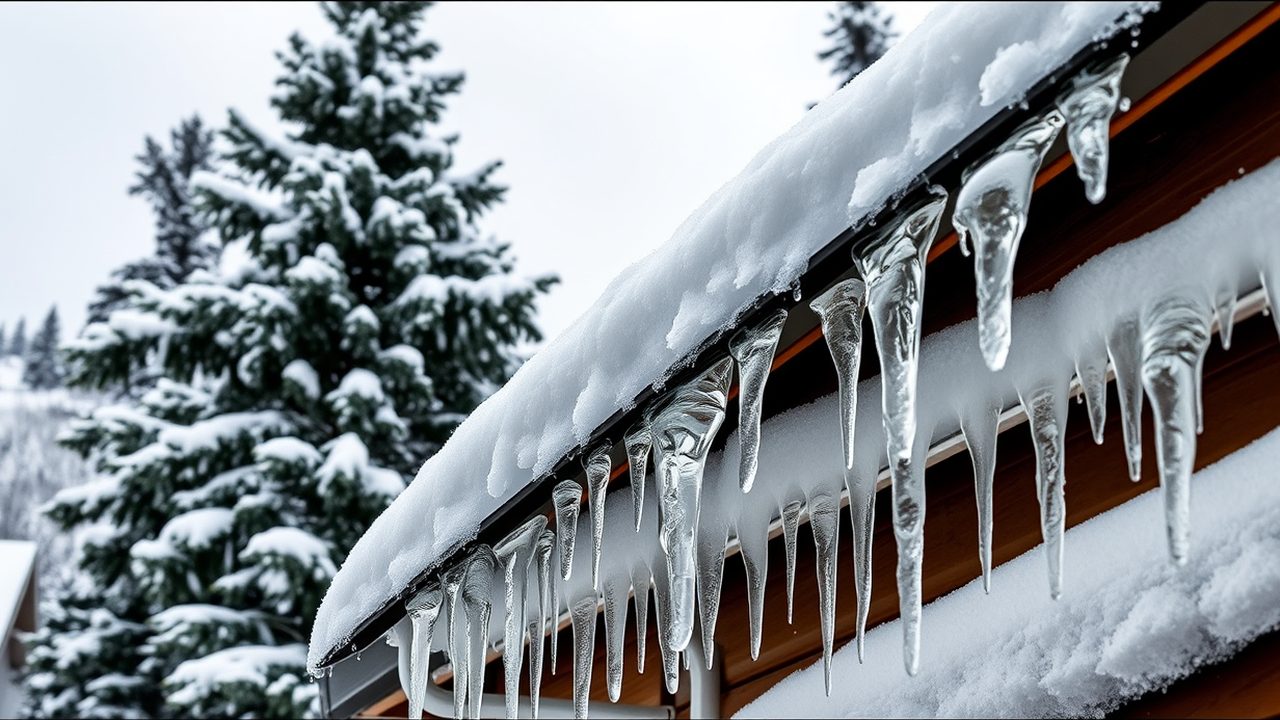
An ice dam forms when heat escaping the living space melts snow on the upper roof, the meltwater runs down to the cold eave, and it refreezes there into a ridge of ice. Water then pools behind the dam and works backward under the shingles, because shingles are designed to shed water flowing down, not to hold water sitting still.
Resulting interior water damage — ruined ceilings, insulation, drywall, flooring — is generally covered as a sudden and accidental water discharge under a standard homeowners policy.
Three things usually are not:
- The ice dam removal itself, as maintenance rather than damage.
- Repeat damage from a known, unrepaired condition. After the first claim, the carrier's position is that you are on notice. A second ice dam claim in the same location is where wear-and-tear and neglect exclusions get applied.
- Long-term hidden consequences — the rot, mold, and framing damage from water that has been getting in slowly for three winters. Policies cover sudden and accidental, not gradual.
Both the City of Flagstaff and Coconino County building codes require ice barrier underlayment — a self-adhering membrane along the eaves, beneath the roof covering — precisely because ice dams are expected here rather than exceptional. If your roof predates that requirement or was replaced without it, you are relying on shingles to do a job they were never designed to do. It is worth asking your roofer directly whether ice barrier was installed the last time the roof was done, and worth insisting on it the next time.
Ice dams are also, almost always, an attic problem rather than a roof problem. The cure is air sealing, adequate insulation, and correct soffit-to-ridge ventilation so the roof deck stays cold. Heat cables treat the symptom. If you are getting dams every year, the money is better spent in the attic — and the improvement is permanent, unlike a claim.
The Endorsement Most Flagstaff Homeowners Are Missing
Two coverage items are worth asking about by name.
Water backup and sump discharge or overflow. When meltwater overwhelms a drain, or a sump fails during a thaw, water coming up through a floor drain is excluded by the base policy. The endorsement is typically inexpensive.
Roof settlement on replacement cost, not actual cash value. A growing number of carriers writing in Arizona have moved roofs to a depreciated actual cash value schedule based on age. On a 20-year-old roof this can mean a five-figure difference on a claim that you will not discover until you file one. Pull your declarations page and look for an ACV roof or roof surfaces endorsement.
Before the Next Storm
- Know your roof's design load and whether every part of the structure meets it — especially additions, enclosed porches, carports, and outbuildings.
- Watch the lower roofs and the valleys, not the main field of the roof. That is where drift and slide-off concentrate.
- Take rain-on-snow forecasts seriously. That is the load event.
- Hire a professional for roof snow removal. Every winter produces both falls and roof damage caused by homeowners with the wrong tool. Roof rakes used from the ground are fine; people on an icy 6:12 pitch are not.
- Keep gutters clear going into winter and address attic heat loss before it snows, not after the dam forms.
- Photograph the roof each fall. Pre-loss condition documentation is the most useful free thing you can do, and it defeats most wear-and-tear arguments.
- Report promptly. Policies require prompt notice, and a claim reported in April for damage that happened in January invites an argument about how much of the damage is yours.
What About the Rest of Winter?
Snow load and ice dams get the attention, but three other winter exposures produce more Flagstaff claims by count.
Trees. A ponderosa loaded with wet snow drops limbs, and sometimes drops entirely. If a tree falls on your house, a detached garage, or a fence, the damage to the structure is covered. Removal of the tree is covered only up to a modest sublimit — often a few hundred to a thousand dollars — and only when it hit something insured. A tree that falls in your yard and hits nothing is generally your problem to remove, at your expense, and healthy mature ponderosa are not cheap to take down.
Vehicles. Snow sliding off a roof onto a parked car, a limb through a windshield, and winter collisions on icy pavement are all comprehensive or collision auto claims, with your auto deductible — not homeowners claims. The distinction matters because people routinely file the wrong one.
Frozen and burst pipes in unheated spaces. Crawl spaces, garages, exterior walls on the north elevation, and hose bibs left connected. Covered, subject to the reasonable-care condition above, but the water damage from a pipe that burst while you were away for a week is an expensive way to learn where your shutoff is.
There is also a liability dimension that homeowners underweight. If a delivery driver or a guest falls on your unshoveled walk, that is a Coverage E liability claim. Arizona applies comparative fault, so their own carelessness reduces what they recover — but it does not eliminate your exposure, and it does not stop the claim from being filed. Keeping walks and steps cleared is risk management, not just courtesy.
The Coverage Review Worth Having
Winter claims in Flagstaff are rarely about whether snow is a covered peril. They are about detached structures, the collapse definition, roof valuation, and whether the addition on the back of the house was engineered for 60 psf.
Those are all answerable in a fifteen-minute read of your declarations page — before January, ideally. We are happy to do that read with you. Call 844-967-5247 or email josh@contractorschoiceagency.com.
Talk to a Northern Arizona Agent
Every property and every business is different. We are an independent agency — we shop your coverage across 40+ carriers and tell you plainly where the gaps are.