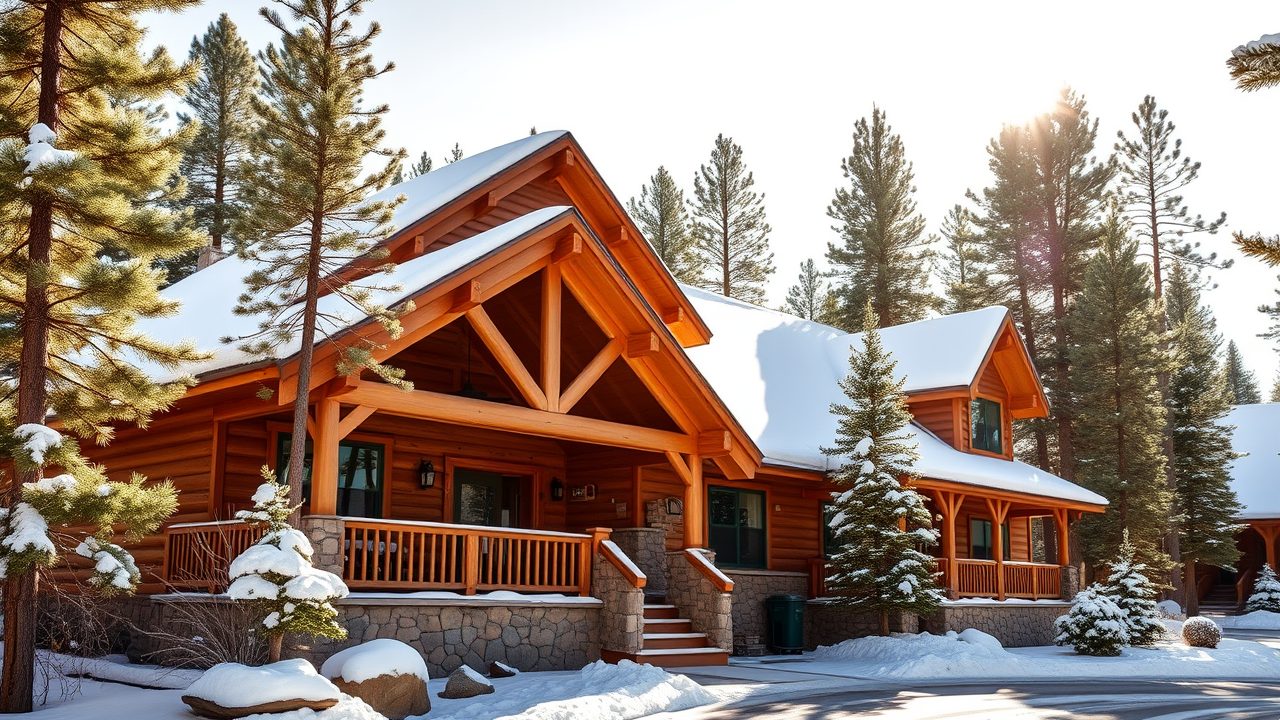
Flagstaff Is Built for This, Which Is the Problem
Flagstaff has close to ideal short-term rental economics and four separate demand cycles stacked on one another. Arizona Snowbowl — which averages 260 inches of snow a year and runs from mid-November into May under a special use permit from the Coconino National Forest — draws skiers from Phoenix and Tucson all winter. The city sits 80 miles south of the Grand Canyon and absorbs that traffic all summer. Northern Arizona University, with university-wide enrollment of 27,184 in Fall 2025, brings move-in weekends, family visits, and graduation. And Route 66, Lowell Observatory, and the dark-sky designation keep a tourism baseline year-round.
The result is a lot of Flagstaff houses being rented by the night, and a substantial number of them insured under a policy that excludes exactly that.
The Exclusion
Every standard homeowners policy contains a business pursuits or business-use exclusion. Renting your home to transient guests for money is a business activity. The policy was underwritten and priced on the assumption that you live in the house.
The consequences of the mismatch are not subtle:
- A liability claim from a guest can be denied outright. Guest slips on the icy deck stairs in February, breaks a wrist, sues. Your homeowners liability coverage is the thing you were counting on, and the business-use exclusion is what the carrier will cite.
- Property damage caused by paying guests may be excluded even when the peril itself is covered.
- The carrier can rescind or non-renew the policy on discovering undisclosed commercial use, sometimes retroactive to inception for material misrepresentation.
- In a total loss from an unrelated cause — a wildfire, say — undisclosed rental use gives the carrier a coverage defense on the entire claim.
That last one is why this is not a small administrative matter. You can lose a wildfire claim over an Airbnb listing.
Do not assume a phone call fixes it either. Many carriers will simply decline to continue the policy once you tell them, which is uncomfortable but far better than finding out at claim time.
What Arizona Law Actually Says
Arizona's short-term rental framework is unusual and worth understanding, because it explains why Flagstaff regulates the way it does.
A.R.S. § 9-500.39, originating in Senate Bill 1350 (2016), preempts local government: an Arizona city or town may not prohibit vacation rentals or short-term rentals, and may not restrict them solely on the basis of how long or how often a property is rented. A short-term rental is defined broadly as a single-family or one-to-four-family dwelling, condominium, or cooperative unit offered for transient use of fewer than 30 days.
That preemption is why Flagstaff cannot ban short-term rentals in residential zones the way many mountain towns elsewhere do.
Later amendments — including changes in 2019 and 2022 — restored a meaningful slice of local authority. Arizona jurisdictions may now:
- Require a local regulatory permit or license, with the fee capped at the actual cost of issuing it or $250, whichever is less
- Impose occupancy limits
- Require a designated emergency contact reachable by the city
- Enforce health, safety, building, fire, sanitation, traffic, and waste rules
- Enforce nuisance and noise ordinances against the property
- Require the owner to carry liability insurance of at least $500,000
That last bullet is the one to write down. Arizona statute contemplates a $500,000 minimum liability requirement for short-term rentals — and a standard homeowners policy that excludes business use does not satisfy it in any meaningful sense, regardless of the limit printed on your declarations page.
What Flagstaff Specifically Requires
Flagstaff has used that restored authority. The City has required a short-term rental license since November 2023, under City Code Chapter 3-12. As of the most recent ordinance update the license fee is $250 — raised from $185 — and the City requires the owner to carry liability insurance of at least $500,000.
Roughly a thousand properties currently appear in the City of Flagstaff's public short-term rental permit portal, which the City publishes and keeps current.
Legislation in this area continues to move; bills amending § 9-500.39 have been introduced in recent sessions, and the City updates Chapter 3-12 periodically. Confirm the current permit, fee, and insurance requirements directly with the City before you list, and re-check annually.
Platform Coverage Is Not Your Policy
Airbnb's AirCover and Vrbo's liability program are real and they are not nothing. They are also not a substitute for a property policy, for four structural reasons.
- They are generally excess, not primary. They sit above your own insurance and are designed to respond after it, which is an awkward arrangement when your own insurance is a homeowners policy that excludes the activity.
- They cover only bookings made through that platform. A direct booking, a repeat guest who texts you, a friend-of-a-friend, or a long-term tenant between seasons is outside the program entirely.
- They do not cover your building against its own perils. Fire, wind, snow load, burst pipes, and hail are your property policy's job. The platform program is not a homeowners replacement.
- They do not cover the gaps that actually recur — lost rental income during repairs, theft by a guest under many program terms, wear and tear, or your liability arising outside a covered stay.
Treat platform coverage as a backstop layer on top of a real policy, never as the policy.
What the Right Structure Looks Like
Which form you need depends on how the property is used.
Occasional rental of your own home — you live there and rent it a handful of weekends a year. Often solvable with a home-sharing or short-term rental endorsement added to your existing homeowners policy. Cheapest path. Availability varies sharply by carrier, which is exactly the kind of thing an independent agency is for.
Dedicated short-term rental you do not occupy — this needs a commercial or specialty short-term rental program policy, or in some cases a dwelling fire (DP-3) policy with the right endorsements. This is the correct answer for most Flagstaff cabins bought as investments.
Either way, make sure the policy addresses:
- Liability at $500,000 minimum, and realistically $1,000,000 — a guest injury on a snow-covered stair set with a two-story great room is not a $500,000 exposure
- Building coverage on a replacement cost basis, with the dwelling limit set to a current Flagstaff rebuild cost
- Contents coverage for furnished rental property. A fully furnished STR carries far more owner-owned personal property than a standard rental — furniture, linens, kitchenware, televisions, outdoor equipment
- Business income / loss of rents. If a burst pipe takes the property offline from December through March, you have lost your peak season. This is frequently the largest dollar figure in the whole claim and it is an optional coverage
- Guest-caused damage and theft, explicitly
- A commercial umbrella over the top. Inexpensive relative to what it does
- Workers compensation if you employ a cleaner or caretaker directly rather than contracting a company. Arizona requires workers compensation for employers with as few as one employee
Flagstaff-Specific Underwriting
Three local factors will shape your quote and are worth preparing for.
Wildfire. Everything in the standard Northern Arizona wildfire underwriting applies — defensible space, roof class, ember-resistant venting, brush clearance, protection class. An unoccupied rental in a forested subdivision is a harder risk than an owner-occupied home in town, because there is nobody there to notice.
Snow. Flagstaff's 60 psf design snow load, ice dams, and the reality that a rental property may sit empty and unmonitored through a heavy storm cycle. Freeze coverage typically requires that heat be maintained or the system drained — with a rental that sits vacant between bookings in January, that condition is a live compliance obligation, not boilerplate. Smart thermostats with low-temperature alerts and water shutoff sensors are worth the money and some carriers credit them.
Hot tubs, decks, and fire pits. The three most common STR amenities in a mountain town are also three of the most common liability surcharges and, at some carriers, outright declinations. Disclose them. An undisclosed hot tub is a coverage argument waiting to happen.
What It Costs, and Why the Range Is So Wide
Owners always want a number, and the honest answer is that short-term rental premiums in Flagstaff vary more than almost any other line we place. The spread is driven by a small number of factors:
- Wildfire rating of the specific address. This is the largest single variable in Northern Arizona and it is address-specific, not ZIP-specific. Two houses a quarter mile apart can rate very differently on brush proximity, slope, and access.
- Whether the property is occupied by anyone the rest of the time. A dedicated rental that sits empty midweek in shoulder season rates worse than a home you live in and rent occasionally.
- Replacement cost of the structure, which at 7,000 feet with a 60 psf roof design is higher per square foot than most of Arizona.
- Amenities. Hot tub, pool, wood stove, fire pit, trampoline, and dog policy all move liability pricing.
- Whether you are buying loss of rents, and for how many months.
The one thing that reliably does *not* save money is under-insuring the dwelling. In a market where a total loss means rebuilding in a constrained mountain construction economy, a low Coverage A limit is a deferred loss rather than a saving.
The Long-Term Tenant Question
A number of Flagstaff owners run a hybrid: nightly rentals through the Snowbowl season and the summer canyon traffic, then a nine-month lease to NAU students, or the reverse.
That hybrid is a real insurance problem, because a short-term rental policy and a landlord policy are different products underwritten on different assumptions, and a policy written for one does not automatically respond to the other. If your use changes seasonally, the policy has to be written knowing that from the start. Switching quietly and hoping is the same mistake as the homeowners-policy-with-an-Airbnb-listing, one layer up.
Tell your agent the full annual pattern, including the months the property is vacant. Vacancy clauses are the most commonly triggered condition in this whole category.
The Practical Order
- Confirm the City of Flagstaff permit, licensing, emergency contact, and insurance requirements currently in force.
- Tell your current carrier what the property is actually used for.
- Place the right form — endorsement for occasional use, STR program or DP-3 for a dedicated rental.
- Set liability at $500,000 minimum, $1,000,000 preferred, and add an umbrella.
- Add loss of rents.
- Treat platform coverage as excess, not primary.
- Re-check annually, because Arizona's STR statute keeps moving.
We write short-term rental coverage across Flagstaff and Coconino County and can tell you quickly whether your situation is an endorsement or a full program policy. Call 844-967-5247 or email josh@contractorschoiceagency.com.
Talk to a Northern Arizona Agent
Every property and every business is different. We are an independent agency — we shop your coverage across 40+ carriers and tell you plainly where the gaps are.