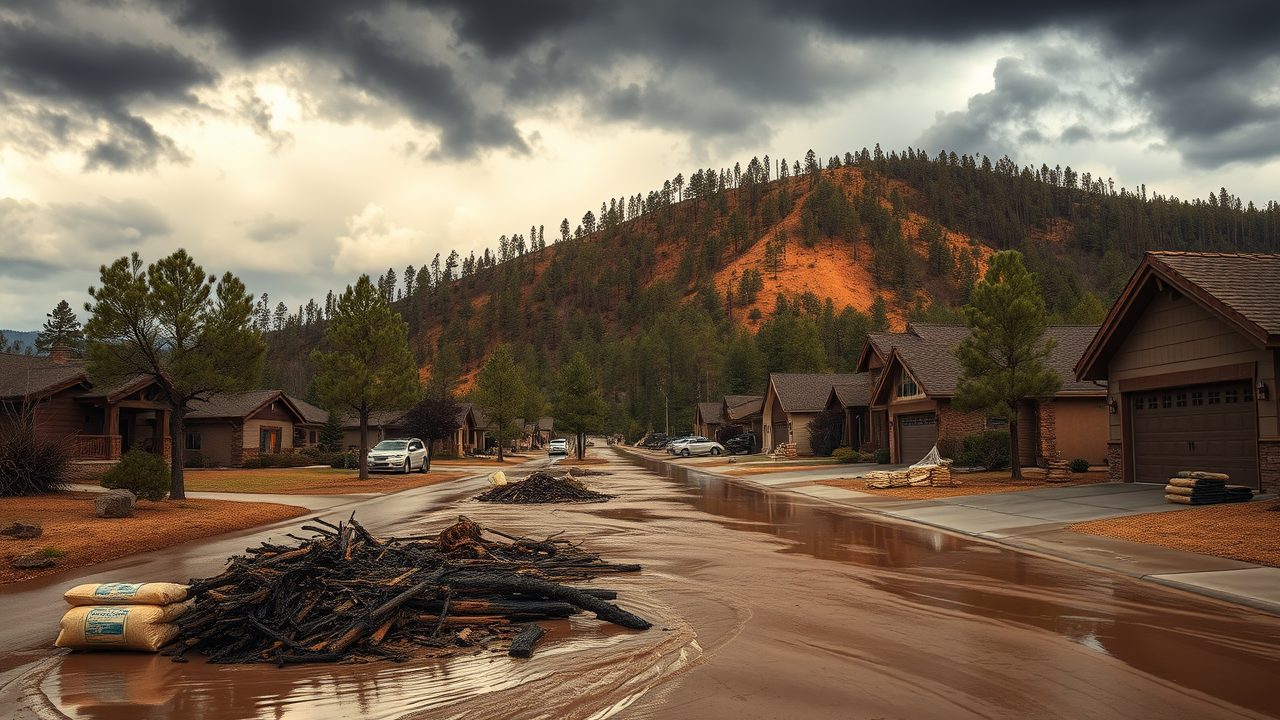
A Fire Uphill Is a Flood Problem Downhill
In July 2019 the Museum Fire burned roughly 800 hectares — about two thousand acres — on the steep slopes of Dry Lake Hills and Mount Elden, directly uphill of Flagstaff. No homes burned.
Then it rained.
The neighborhoods of Paradise and Sunnyside sit inside Flagstaff city limits roughly a mile and a half downstream of that burn, at the toe of inactive alluvial fans and alongside Spruce Wash — a broad, ephemeral drainage that for most of the last century had no defined channel because it had never needed one. A forested watershed absorbs rain. A burned watershed does not; the soil goes hydrophobic, the litter layer that slowed water is gone, and the same monsoon cell that used to produce nothing now produces a wall of water carrying ash, sediment, and burned timber.
Researchers documenting four separate flood events in 2021 measured on the order of 9,900 megagrams of sediment — roughly ten thousand tons — delivered into Flagstaff neighborhoods. Not water. Sediment.
The City of Flagstaff and Coconino County have since completed a $39.5 million program of flood mitigation on Spruce Wash serving the Grandview and Sunnyside areas: engineered channels, storm drain improvements, debris and sediment basins, and emergency alert sirens. It is a serious piece of public infrastructure and it has meaningfully reduced the hazard.
It did not eliminate it, and it does not pay for your drywall.
The Two Sentences That Cost People Everything
Homeowners insurance does not cover flood. It never has.
Every standard homeowners policy written in Arizona — HO-3, HO-5, dwelling fire, renters, condo — excludes flood. The exclusion language typically covers "flood, surface water, waves, tidal water, overflow of a body of water, or spray from any of these, whether or not driven by wind."
Read that middle phrase again: surface water. That is the one that catches Flagstaff. You do not need a river. Water sheeting down a street and through a garage door after a monsoon burst on a burn scar is surface water, and it is excluded.
And the second sentence:
Being outside a FEMA high-risk flood zone is not evidence that you will not flood.
Some of the Flagstaff post-fire corridor *is* mapped — Spruce Avenue Wash appears in the Flood Insurance Study — but a great deal of burn-scar runoff arrives at properties that carry no high-risk designation at all. FEMA's own figure is the one to hold onto: roughly a third of NFIP flood claims nationally come from outside high-risk flood zones.
That produces a specific and dangerous outcome. Where a property is not in a high-risk zone, no lender requires flood insurance, so almost nobody buys it, so almost nobody has it when the water arrives.
The scale of the change is measurable. NOAA's Storm Events records for Coconino County show 35 flash flood events in 2021 and 51 in 2022, against an average of roughly 9 per year across the preceding eleven years. That is not a wetter decade. That is what burned watersheds do to runoff, and it is why burn-scar flooding here has been severe enough to prompt a request for National Guard assistance.
When Flagstaff Floods
Arizona's monsoon runs officially from June 15 through September 30. In an average year the monsoon supplies a large share of Flagstaff's annual precipitation, and it does so in short, violent, highly localized bursts — an inch of rain in forty minutes over one drainage while a neighborhood two miles away stays dry.
That delivery pattern is what makes burn scars dangerous. The rate matters more than the total. A slow winter storm soaks in; a monsoon cell over a hydrophobic burn scar runs off almost entirely.
There is a second, smaller season: rapid spring snowmelt on a heavy snow year, particularly when a warm rain lands on an existing snowpack.
Your Actual Options
NFIP — The National Flood Insurance Program
Written by FEMA through participating insurers. Both the City of Flagstaff and Coconino County participate, so NFIP coverage is available here.
- Building coverage up to $250,000 and contents coverage up to $100,000 for a residential property.
- Contents are a separate purchase. Buying only building coverage — very common — means the flood pays for your subfloor and nothing standing on it.
- Basements and below-grade areas are sharply limited. Finished basement walls, floors, and personal property are largely not covered.
- There is a 30-day waiting period before a new policy takes effect. As a general rule this ends the conversation every summer: you cannot buy flood insurance when the forecast turns, because the storm you are watching is already inside the waiting period.
The Post-Wildfire Exception Almost Nobody in Flagstaff Uses
There is an exception to that waiting period, and around here it applies far more often than people realize.
NFIP waives the 30-day wait where the flooding is caused by post-wildfire conditions on federal land, provided the policy is purchased within 60 days of the fire's containment. The Museum, Schultz, Tunnel, and Pipeline Fires all burned on the Coconino National Forest — federal land.
That means the window to get flood coverage in force *without* waiting a month opens the moment a fire on the forest is contained, and closes 60 days later. It is a narrow, time-limited, and genuinely valuable exception, and in practice it expires unused because homeowners are still dealing with evacuation and smoke when the clock is running.
If a fire burns above your neighborhood on Forest Service ground, call about flood insurance that week. Not next spring.
If your home is not in a mapped high-risk zone, ask specifically about a Preferred Risk Policy — NFIP's lower-cost option for properties outside the SFHA. Post-fire exposure outside the flood map is exactly the situation it exists for.
Private Flood
The private flood market has grown substantially and is now genuinely competitive with NFIP in much of Arizona. It is worth quoting alongside, not instead of.
| NFIP | Private flood | |
|---|---|---|
| Building limit | $250,000 maximum | Often $500,000 or more |
| Contents limit | $100,000 maximum | Higher limits available |
| Loss of use / additional living expense | Not covered | Frequently included |
| Waiting period | 30 days | Often shorter, commonly 10–14 days |
| Availability | Anywhere the community participates | Underwritten; can decline your address |
That "not covered" cell is the one homeowners miss. NFIP pays nothing toward temporary housing. If mud fills your first floor in August and you are out of the house for five months, an NFIP policy will repair the house and will not pay for anywhere to sleep. Many private flood policies will.
What Neither One Covers
Vehicles. A car flooded in your driveway is a comprehensive auto claim, not a flood claim — which means it is covered only if you carry comprehensive, and it is subject to your auto deductible. Every monsoon season somebody discovers they dropped comprehensive on an older paid-off vehicle.
Water Backup Is a Different Thing Entirely
Sewer or drain backup — water coming *up* through a floor drain or a fixture rather than in from outside — is excluded by a standard homeowners policy and is also not flood. It is its own endorsement, usually inexpensive, and it is a real exposure in older Flagstaff neighborhoods during heavy monsoon flow. Ask for it by name: water backup and sump discharge or overflow.
If You Live Below a Burn Scar
Practical steps, roughly in order of value:
- Find out what is uphill of you. Not what is next to you — what drains toward you. Coconino County and the City of Flagstaff both publish post-fire flood information and project maps for the affected watersheds.
- Buy the flood policy in spring. The 30-day waiting period means April and May are when this decision gets made, not July.
- Buy contents coverage, not just building.
- Ask about additional living expense and let that drive the NFIP-versus-private comparison.
- Add the water backup endorsement to your homeowners policy.
- Confirm you carry comprehensive on every vehicle that parks outside.
- Elevate the mechanicals. Furnace, water heater, and electrical panel off the floor of a garage or basement. This is a mitigation step that also reads well to underwriters.
- Sign up for Coconino County emergency alerts, and know what the Spruce Wash sirens mean if you are in their coverage area.
- Keep sandbags before you need them. Flagstaff and the County have run fill sites during active post-fire seasons; the queue on the day of a warning is not where you want to learn the location.
How Long Does Post-Fire Risk Last?
The most common question after a fire is when the flood risk goes away, and the honest answer is that it decays rather than ends.
Watershed recovery depends on burn severity, slope, aspect, and how quickly ground cover reestablishes. On the steep, high-severity portions of a Northern Arizona burn, elevated runoff and debris-flow potential is generally treated as a multi-year condition — commonly discussed in the range of three to five years for the sharpest risk, longer on the worst slopes, and longer still where soils were severely burned. Federal burned-area response teams assess this directly after each fire and their findings drive the local emergency planning.
What that means practically: the second and third monsoon seasons after a fire are not safe seasons. The 2021 flood events that pushed thousands of tons of sediment into Flagstaff neighborhoods came two years after the Museum Fire, not two weeks.
It also means the reverse is true. Post-fire flood risk is one of the few hazards that genuinely improves with time and with public investment, and both have been happening in Flagstaff. The mitigation infrastructure on Spruce Wash is real, the watershed is recovering, and a house that was frightening in 2021 is in a better position now. That is an argument for reviewing your coverage periodically — not for skipping it.
The Honest Summary
Flagstaff has an unusual insurance geometry. The fire risk everyone talks about is genuinely serious — but for a large number of households the fire that damages their home will be a fire that burned somebody else's watershed two years earlier, and the damage will arrive as water. That risk is excluded from the policy they already have, is not flagged by the flood map, and — outside the narrow post-wildfire window above — cannot be bought on 48 hours' notice.
If you are in Paradise, Sunnyside, Grandview, or anywhere downstream of a Coconino County burn scar, this is worth thirty minutes and usually a few hundred dollars a year.
We will look at your address, tell you what is uphill of it, and quote NFIP and private flood side by side. Call 844-967-5247 or email josh@contractorschoiceagency.com.
Talk to a Northern Arizona Agent
Every property and every business is different. We are an independent agency — we shop your coverage across 40+ carriers and tell you plainly where the gaps are.